
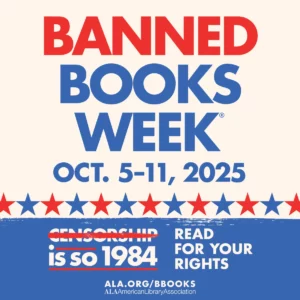
What is Banned Books Week?
A week of reflection of censorship, information, and citizenship
Why does it matter?
Concerning censorship, we as a public institution believe that the best way to stay informed, is to approach a subject from every angle, not just the angles that already agree with you. Rather than picking what information you are allowed to consume, we believe that you should be allowed to consume whatever information you desire, and create your own well-informed decisions afterward.
Does the government really ban books?
No. The government does not yet have the authority to ban the sale and distribution of books, because it protected under our First Amendment rights in Freedom of Speech. If you are eligible to vote, asking your representatives about their stance on the Right to Read would be helpful in understanding the policies they envision.
What do we do during Banned Books Week?
Personally, I think Banned Books Week is a bit of a misnomer. It kind of sounds like we’re celebrating the banning of books, but the reality is a lot more somber. This isn’t a celebration, but a reflection of values, of freedom, of what it means to read without censorship. Book banning is…”the practice of prohibiting or restricting the reading of certain books by the general public or by members of a local community or religious group.” (Volle. 2023).
During Banned Books Week, we encourage everyone to look into the titles that people have tried to take off the shelves, the reasons why, and the potential repercussions.
Isn’t this a little too political?
I believe a better question is, why is our ability to read what we like a matter of political discourse to begin with? It is impossible to exist inside a vacuum, free of context. Any choice can be political in its proximity to change. Consider that it was once illegal for women to exit the home wearing pants, and so in an abstract sense, women wearing pants today could be seen as a political statement. Does anyone actually frame it that way when they get dressed? No. That is because of its proximity to ubiquity.
Why are books usually banned?
Books are usually banned for different reasons, depending on who’s banning them. For example, Animal Farm has been banned from countless libraries, but the reasons are different. In one library, it’s banned because the message is considered too fascist, in another, the very same text is considered too communist. One person’s interpretation can contradict another’s, which is why the banning of books contradicts the very heart of library’s purpose. We want you to read what you like so you can create well-informed interpretations which reflect many different sources.
Recent Comments